




AI has changed what's realistically possible as a side hustle in the last two years — tasks that used to require hiring a team or years of specialized skill can now be done by one person using the right tools. But not every "AI side hustle" being promoted online is equally realistic. Here's a genuinely honest breakdown of what's working in 2026, what the actual barriers to entry look like, and how to think about picking one that fits your situation — including a free event covering this exact topic if you want a structured, guided starting point.
Why AI Changed the Side Hustle Landscape
The core shift is straightforward: AI tools have removed or drastically lowered several traditional barriers to starting a business — needing design skills, needing to write well, needing technical/coding knowledge, and needing significant time to produce content or deliverables. What used to take a specialized skill set or a small team can now often be done by one person with the right AI tools and a clear process.
This doesn't mean AI side hustles are effortless or guaranteed — it means the starting barrier is lower than it used to be, which is genuinely different from saying the path to income is easy or fast.
Comparing the Main AI Side Hustle Categories
Note: the scores above are relative, illustrative comparisons based on general market observation, not precise data from a specific study — use them as a starting framework for comparison, not exact figures.
AI Content Creation
Using AI tools (ChatGPT, Claude, Midjourney, etc.) to produce written content, social media posts, or basic graphics for clients or your own platforms. This has a relatively low barrier to entry since the tools themselves are inexpensive or free, but income potential is moderate since this category has become increasingly crowded, and clients increasingly expect AI-assisted work as standard rather than a premium service.
AI Automation Services
Building automated workflows for businesses — think automated customer service responses, appointment scheduling, lead follow-up sequences, or data processing pipelines using tools like Make, Zapier, or custom AI integrations. This has a higher barrier to entry since it requires understanding both the business problem and the technical implementation, but the income potential is meaningfully higher since businesses will pay well for systems that genuinely save them time and reduce staffing costs.
AI-Assisted Freelancing
Using AI to significantly speed up traditional freelance work — copywriting, graphic design, video editing, virtual assistant work — allowing you to take on more clients or higher-value work in less time than doing everything manually. Moderate barrier to entry (you generally need at least a baseline skill in the underlying freelance category), with solid income potential since you're combining an existing marketable skill with AI-driven efficiency.
Selling AI Prompts or Prompt-Based Tools
Creating and selling prompt packs, GPTs, or simple AI-powered tools/templates. This has the lowest barrier to entry of any category here, but also the lowest realistic income potential for most people, since this specific market has become heavily saturated and buyer expectations for quality have risen significantly since AI tools first went mainstream.
AI Social Media Management
Using AI tools to manage content creation, scheduling, and engagement for businesses' social media accounts — similar to traditional social media management, but significantly faster and more scalable using AI for caption writing, content ideas, and even automated posting. Moderate-to-higher barrier to entry (you need to understand both social media strategy and the AI tools), with solid income potential since ongoing retainer-based client work tends to be more stable than one-off projects.
Reselling AI Software / Affiliate Marketing for AI Tools
Promoting AI tools, courses, or software as an affiliate, earning commissions on signups or sales. Low barrier to entry (no product creation required), but income potential is genuinely inconsistent — it depends heavily on whether you already have an audience or following to promote to, since cold affiliate marketing without any existing reach is significantly harder than the marketing for these programs typically suggests.
What Actually Determines Success in an AI Side Hustle
Based on general patterns across this category, a few factors matter more than which specific AI hustle you pick:
Existing audience or network. People who already have some kind of following, professional network, or existing client base generally see faster results than people starting from zero, regardless of which specific AI side hustle they choose. This is one of the most commonly underemphasized factors in "AI side hustle" marketing — the case studies often feature people who had some existing advantage (an audience, a skill, a network) that isn't always disclosed clearly.
A specific, narrow starting focus. Trying to do "AI content creation" broadly is harder than picking a specific narrow lane — for example, AI-assisted LinkedIn ghostwriting for B2B founders, specifically. Narrow focus makes it easier to get good at one thing and easier to market yourself to a specific type of client.
Willingness to actually learn the tools deeply, not just use them casually. There's a meaningful difference between someone who's used ChatGPT a few times and someone who understands prompt engineering, tool chaining, and how to troubleshoot when AI output isn't good enough. The second person can charge more and deliver more reliable results.
Realistic time expectations. Genuine income from any side hustle, AI-powered or not, typically takes weeks to months of consistent effort before becoming meaningfully profitable — not days, despite how some marketing in this space frames the timeline.
Common Red Flags in "AI Side Hustle" Marketing
Since this space is heavily marketed, it's worth knowing what to watch for regardless of which specific program or opportunity you're evaluating:
Vague descriptions of the actual business model. If a program won't tell you specifically what the "side hustle" is until after you've registered or paid, that's a common curiosity-driven marketing tactic — not necessarily a scam, but worth noting as a pattern.
Heavy reliance on single outlier success stories. Watch for the same one or two individual results (a specific dollar amount, a specific person) being repeated across multiple pieces of marketing content. This often suggests the example is a standout outlier rather than a typical outcome.
Urgency language disconnected from any real deadline. Phrases like "this opportunity window is closing" or "act now before it's too late" are common persuasion techniques. Sometimes there's a genuine time-limited element (an actual event date, an actual price increase); often it's simply a marketing technique to drive faster decisions.
No discussion of the actual time or skill investment required. Legitimate opportunities generally acknowledge that results take real time and effort. Be more cautious of anything implying meaningful income with minimal time or skill investment.
How to Actually Get Started
Pick one category, not several. Based on the comparison above, choose the AI side hustle category that best matches your existing skills or interests, rather than trying to pursue multiple approaches simultaneously.
Learn the tools properly before trying to monetize. Spend genuine time understanding whichever AI tools are core to your chosen category — this investment pays off in both work quality and your ability to actually deliver what you're promising to clients or customers.
Start with your existing network, even if it's small. Your first few clients or customers are significantly easier to find through people who already know you than through cold outreach or advertising to strangers.
Track your actual time investment honestly. Understanding how many hours you're realistically putting in relative to income generated helps you evaluate whether a specific approach is working, rather than relying on assumptions or marketing promises about effort required.
Frequently Asked Questions
What's the easiest AI side hustle to start in 2026? Selling AI prompts or simple AI-powered tools generally has the lowest barrier to entry, though it also tends to have lower income potential due to market saturation. AI content creation is also relatively accessible for beginners with some existing writing or content skills.
Which AI side hustle has the highest income potential? AI automation services for businesses tend to have the highest income potential, since businesses are willing to pay meaningfully for systems that save time and reduce staffing costs, but this category also has a higher technical barrier to entry.
Can I really make money with AI with no experience? It's possible, but genuinely takes real time, consistent effort, and typically some combination of an existing skill or network to accelerate results. Marketing that implies significant income with no experience and minimal effort should be evaluated critically.
Do I need to know how to code to do AI automation work? Not necessarily at a professional software engineering level, but you do need to understand how to use no-code/low-code automation platforms (like Zapier or Make) and how to structure logical workflows, which is its own learning curve.
How long does it typically take to make money with an AI side hustle? Most legitimate approaches take weeks to months of consistent effort before generating meaningful, reliable income — not days, regardless of what specific marketing claims suggest.
Is AI freelancing oversaturated in 2026? Some categories, particularly generic AI content writing, have become more competitive as more people enter the space. Niching down into a specific service, industry, or client type generally improves your chances compared to competing broadly on general AI-assisted freelance work.
Final Thoughts
AI has genuinely lowered the barrier to starting several types of side hustles, but "lower barrier" doesn't mean "no effort required." The categories with the highest income potential (like AI automation services) tend to also require more genuine skill development, while the lowest-barrier categories (like selling AI prompts) tend to have more modest income ceilings due to saturation.
The most realistic path for most people is picking one narrow category that overlaps with existing skills or interests, genuinely learning the relevant tools, and treating it as a real, if smaller-scale, business rather than a quick side project — regardless of how the timeline gets framed in broader marketing around this space.
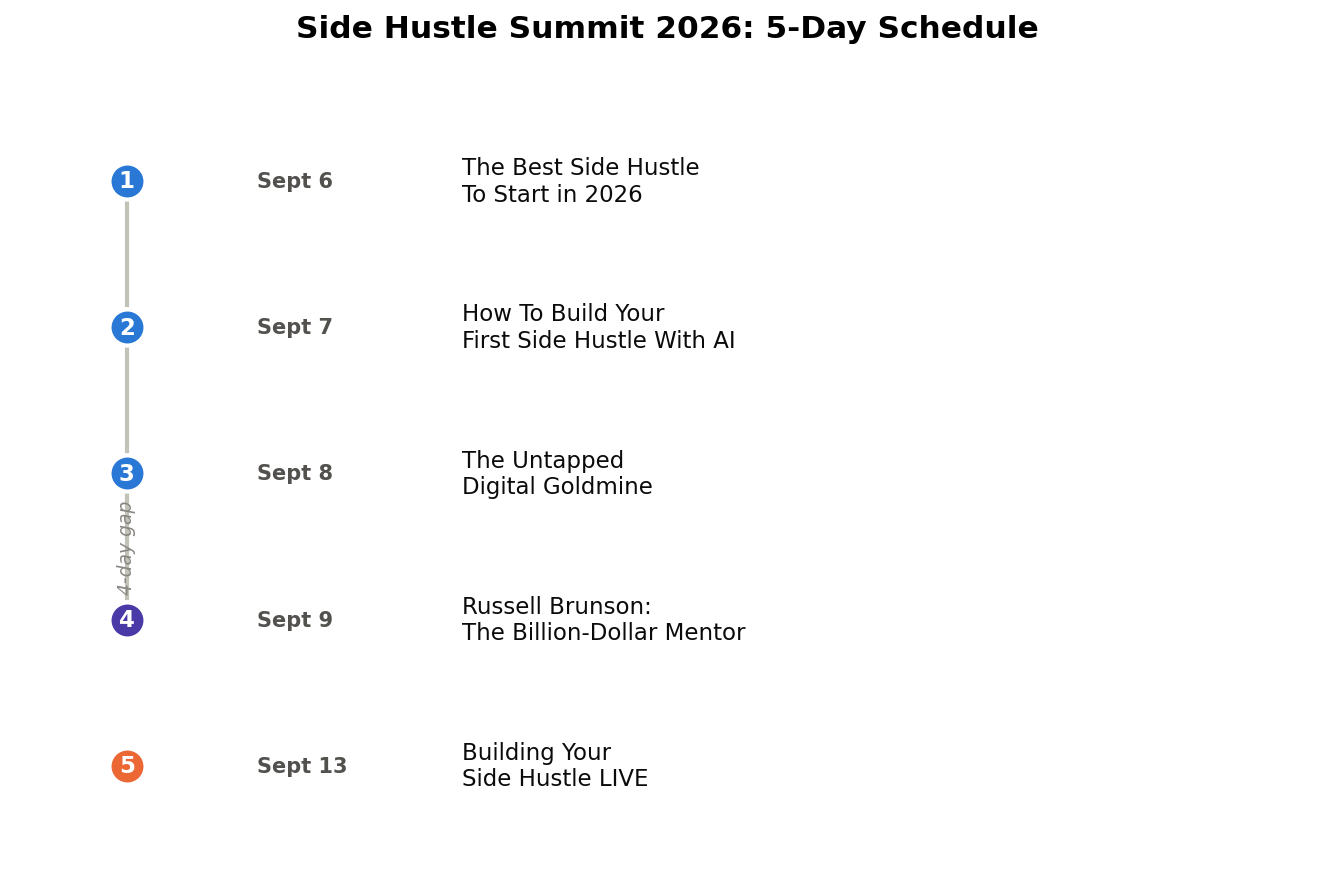
If you want a structured way to explore the AI automation and content side of this — including direct mentorship rather than figuring it out alone — the free Side Hustle Summit covers this exact ground over 5 days, and registration is free.
This post contains affiliate links. If you register or purchase through links on this page, I may earn a commission at no additional cost to you.