
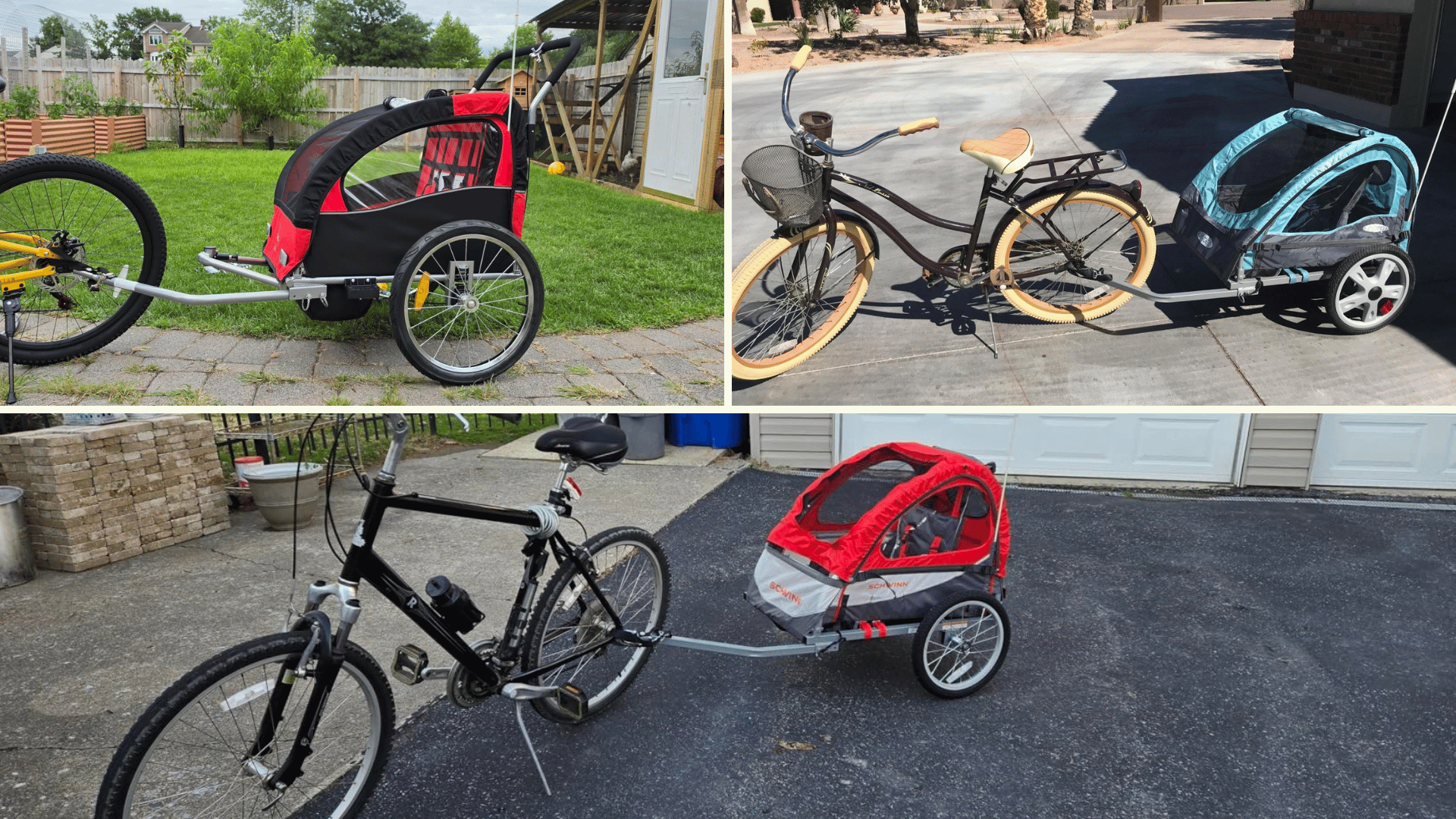


A child bike trailer can make family bike rides much easier when your child is too young to keep up on their own bike.
But there is a surprisingly big difference between trailers.
Some are lightweight single-seat models designed for one child and a few essentials. Others have room for two kids, larger cargo areas, bigger wheels or stroller-style features. More importantly, passenger limits, bike compatibility and manufacturer age requirements can vary from one model to another.
For this guide, we compared six popular child bike trailers based on their published specifications, current manufacturer information and available customer feedback.
We looked closely at:
- Passenger capacity
- Harness design
- Wheel size
- Weather protection
- Visibility features
- Folding and storage
- Cargo capacity
- Bike compatibility
- Manufacturer age requirements
- Important restrictions buyers might otherwise miss
We did not personally road-test all six trailers, so we are not going to pretend we did. Where performance or comfort cannot be verified from published information, we say so.
The best child bike trailers at a glance
| Child bike trailer | Best for | Seats | Published child capacity | Wheels |
|---|---|---|---|---|
| InStep Sync | Best overall for one child | 1 | 40 lb | 16" |
| InStep Take 2 | Best for two kids | 2 | 80 lb | 16" |
| Allen Sports Deluxe | Best higher-capacity double | 2 | 100 lb total | 16" |
| Retrospec Rover | Best for storage and visibility | 1 or 2 | 40/80 lb | 16" |
| Aosom Elite 360 | Best multipurpose design | 2 | 80 lb* | 20" rear |
| Schwinn Trailblazer Plus | Best single with extra storage | 1 | 40 lb + 12 lb cargo | 16" |
*Aosom’s current page contains inconsistent capacity wording. Its detailed specifications show an 80-pound weight capacity and a maximum of 40 pounds per child in trailer mode, while another line mentions 88 pounds. We would use the more conservative 80-pound figure unless the manual for the exact unit states otherwise.
Quick answer: What is the best child bike trailer?
For one child, the InStep Sync Single Seat Bike Trailer is our top overall pick because it combines a 40-pound passenger limit, 16-inch pneumatic tires, a five-point harness, weather protection and a folding frame without becoming unnecessarily large.
For two children, the InStep Take 2 gives you essentially the same straightforward design with an 80-pound combined child capacity.
Families needing more passenger capacity should look closely at the Allen Sports Deluxe, which supports up to 50 pounds per passenger in its two-child configuration and is one of the few models here whose manufacturer specifically states that its trailers pass ASTM trailer safety standards.
1. InStep Sync Single Seat Bike Child Trailer
Best child bike trailer overall for one child
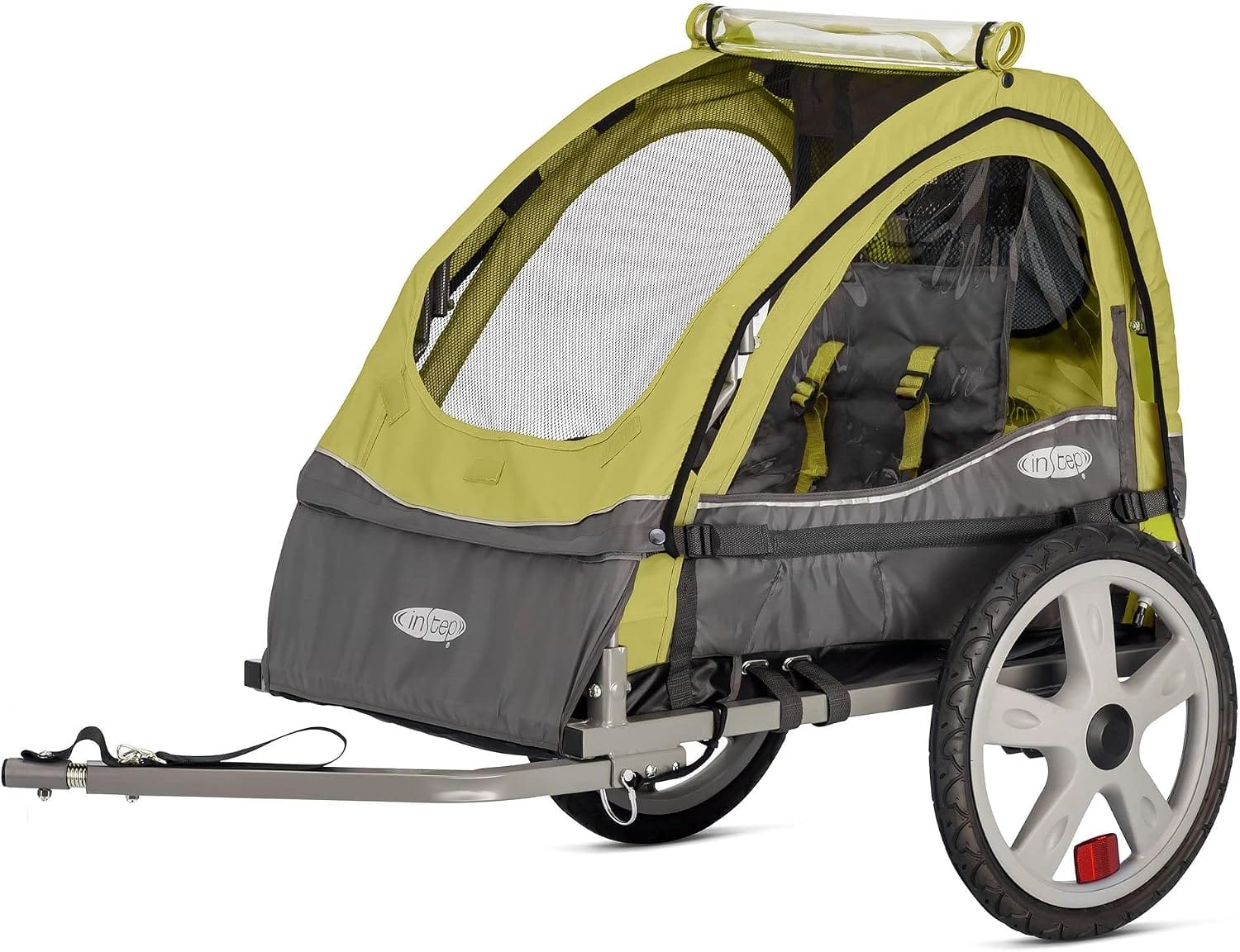
The InStep Sync gets the No. 1 spot because it covers the essentials without making a one-child trailer bigger or more complicated than it needs to be.
It carries one child up to 40 pounds and uses 16-inch pneumatic tires rather than small hard plastic wheels. Air-filled tires can better conform to small surface irregularities, although this is still a recreational child trailer rather than an off-road suspension trailer.
Inside, there is a five-point harness. Outside, a safety flag helps make the low-profile trailer easier to notice.
The canopy combines a mesh bug screen with a weather shield, while a rear vent helps with airflow.
InStep also uses a folding frame and quick-release wheels. That matters more than it sounds if the trailer will spend most of the week inside a garage, closet or vehicle.
The company says its universal coupler attaches the trailer to almost any bicycle, although owners should still verify compatibility with the exact bicycle, axle and manufacturer instructions before riding.
What we like most
The Sync gives a one-child family most of what it actually needs:
40-pound child capacity, 16-inch pneumatic tires, five-point restraint, weather protection, visibility flag and compact storage.
You are not dragging around an unnecessarily wide double trailer every time you ride.
What to consider
This is an entry-level recreational trailer.
There is no adjustable suspension system like you would find on substantially more expensive premium trailers. Families planning long rides over rough surfaces should not assume that pneumatic tires provide the same ride control as real suspension.
The 40-pound capacity also means your child may eventually outgrow it before a larger double trailer.
Best for
One-child families who mainly ride paved bike paths, parks and quiet neighborhood routes and want a straightforward trailer that stores easily.
Skip it if
You need room for two children, adjustable suspension or a much higher passenger capacity.
Key specs
Seats: 1
Maximum child weight: 40 lb
Wheels: 16-inch pneumatic
Harness: Five-point
Canopy: Bug screen + weather shield
Frame: Steel
Storage: Folding frame and quick-release wheels
Attachment: Universal-style bicycle coupler
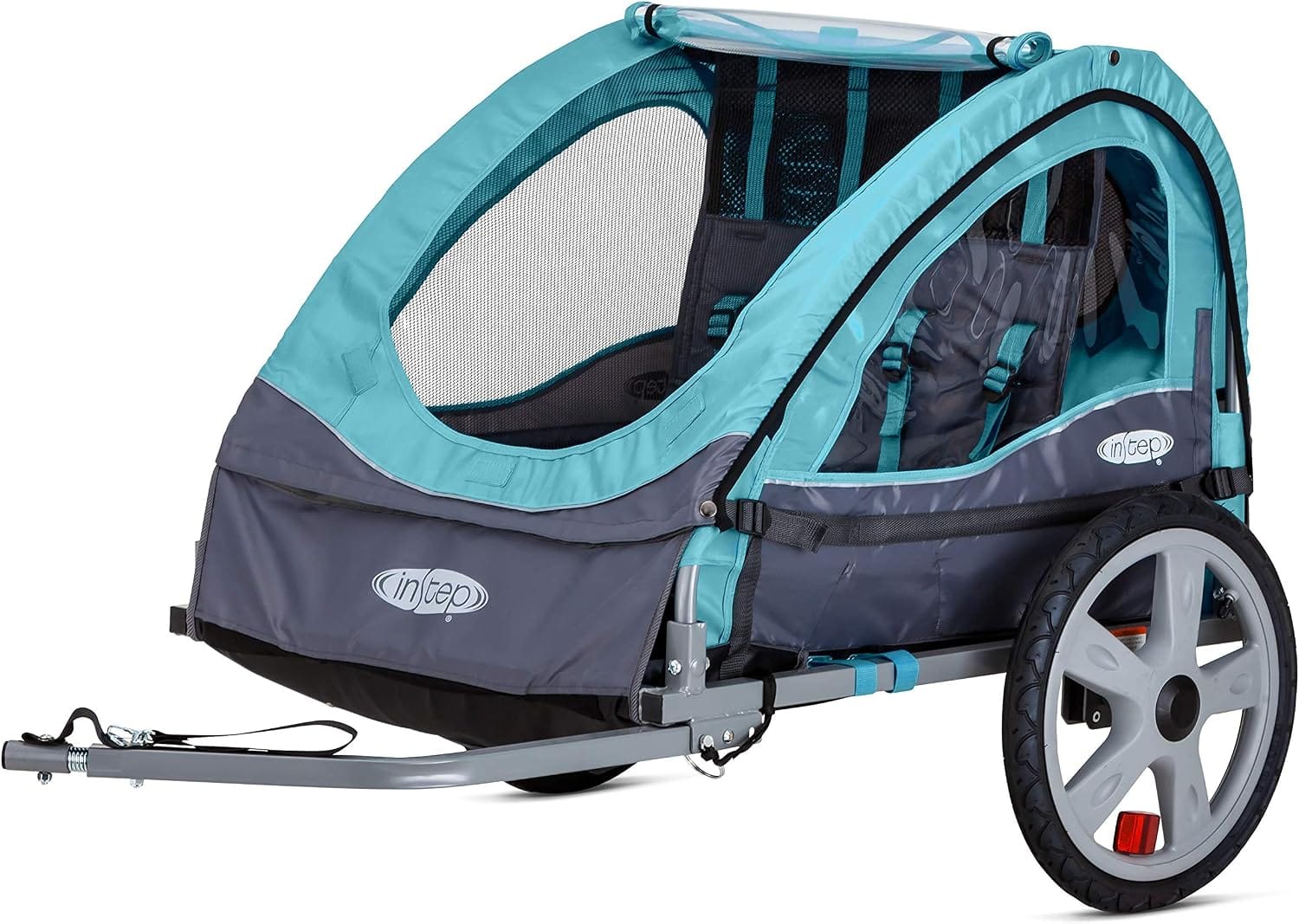
If you like the simplicity of the Sync but need a double child bike trailer, the InStep Take 2 is the logical upgrade.
Instead of one 40-pound passenger, it is designed for up to two children with a published combined child capacity of 80 pounds.
You still get 16-inch pneumatic tires, a folding steel frame, quick-release wheels, a universal coupler, weather shield, bug screen, rear ventilation, five-point harnesses and an included visibility flag.
There is also rear storage for things you inevitably end up carrying when kids come along: water, snacks, jackets and toys.
Why we rank it second
The Take 2 does not try to turn the trailer into a complicated multisport system.
It is essentially a wider family version of the Sync.
That makes it particularly appealing for parents whose main requirement is:
“I have two kids and I want to pull them behind my bike.”
There are fewer extras to think about and fewer features you are paying for without using.
What to consider
Two 40-pound children equal a substantially heavier towing load than one child.
The rider also needs to account for whatever cargo is stored behind them.
Extra mass affects acceleration and braking, so riding with children should be more conservative than riding the bicycle alone. The American Academy of Pediatrics advises adults carrying young passengers to ride cautiously, reduce speed and favor parks, bike paths and quiet streets instead of busy roads.
Best for
Families with two small children who want a straightforward double bicycle trailer rather than a premium stroller/trailer system.
Skip it if
You expect either passenger to exceed 40 pounds or need more sophisticated suspension.
Key specs
Seats: 2
Published child capacity: 80 lb combined
Wheels: 16-inch pneumatic
Harness: Five-point
Canopy: Bug screen + weather shield
Frame: Steel
Storage: Rear cargo area, folding frame and removable wheels
Attachment: Universal coupler
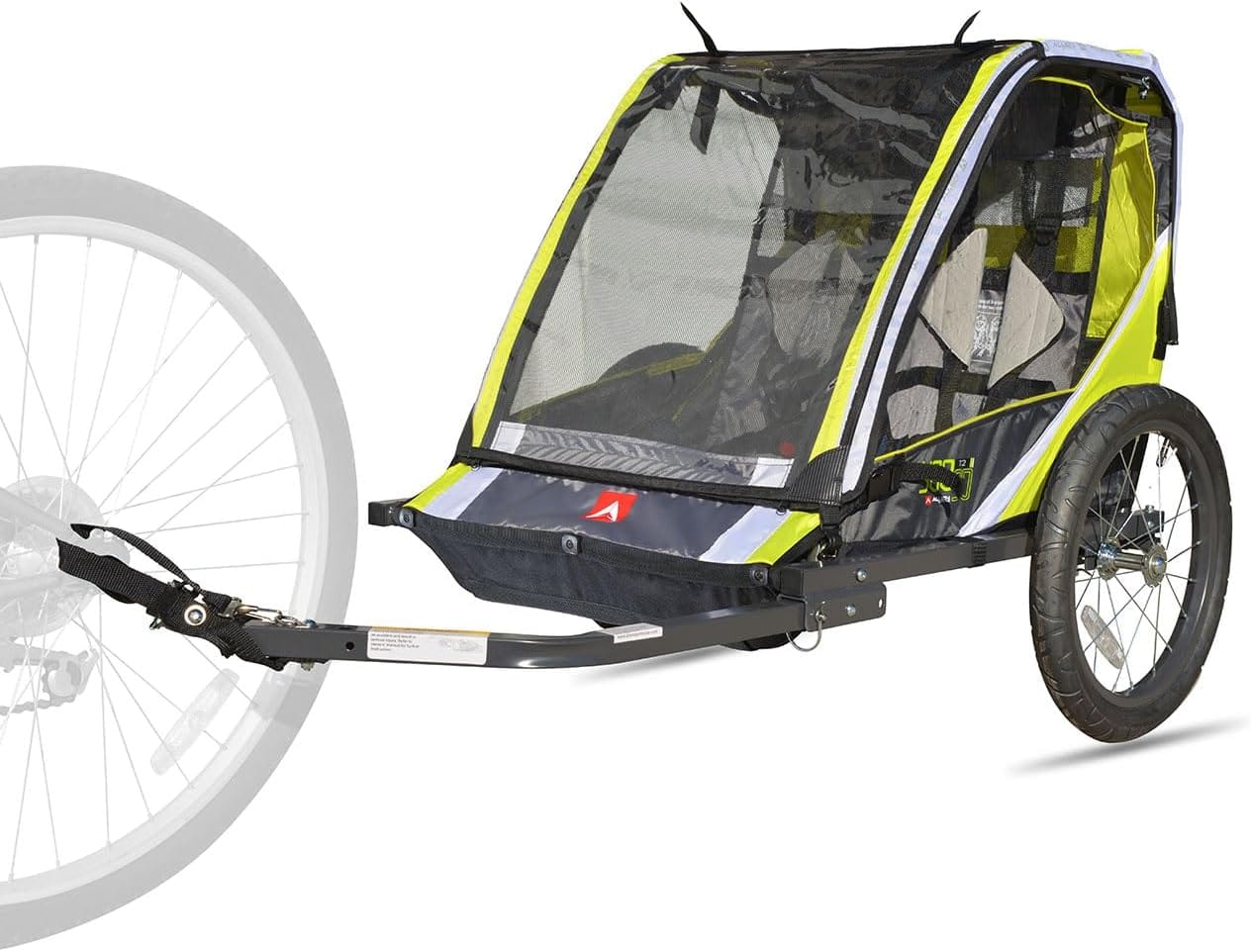
3. Allen Sports Deluxe Steel Child Trailer
Best higher-capacity double child bike trailer
The Allen Sports Deluxe stands out immediately for one number:
100 pounds.
Allen sells the Deluxe in single- and two-child configurations. The double version supports up to 50 pounds per passenger, for 100 pounds of passenger payload.
That gives families more breathing room than double trailers limited to two 40-pound children.
The lightweight steel construction rides on quick-release 16-inch steel wheels. Large front and side windows open up the cabin visually, while a padded five-point harness holds each passenger in place.
A front footguard tube provides another physical barrier around the passenger compartment.
The trailer folds, its wheels remove quickly and a universal coupler connects at the bicycle's rear axle.
One detail we really like
Allen explicitly states that all Allen trailers pass ASTM trailer safety standards.
The CPSC identifies ASTM F1975 as the voluntary standard covering non-powered bicycle trailers designed for human passengers.
That is much more useful information than vague marketing phrases like “safety designed.”
VERY IMPORTANT: E-bike owners
Allen specifically says its child trailers should not be used with electric bicycles.
That restriction alone could determine whether this trailer belongs on your shortlist.
Do not assume a universal hitch automatically means the manufacturer approves every kind of bicycle.
Best for
Families with two children who want up to 50 pounds of passenger capacity per seat.
Skip it if
You plan to tow the trailer with an electric bicycle. Allen specifically says not to.
Key specs
Seats: 2
Maximum payload: 100 lb total / 50 lb per passenger
Wheels: 16-inch quick-release steel wheels
Harness: Padded five-point
Frame: Steel
Windows: Front and side
Attachment: Rear-axle universal coupler
Safety standard: Manufacturer states its trailers pass ASTM trailer safety standards
E-bike compatibility: Manufacturer says no
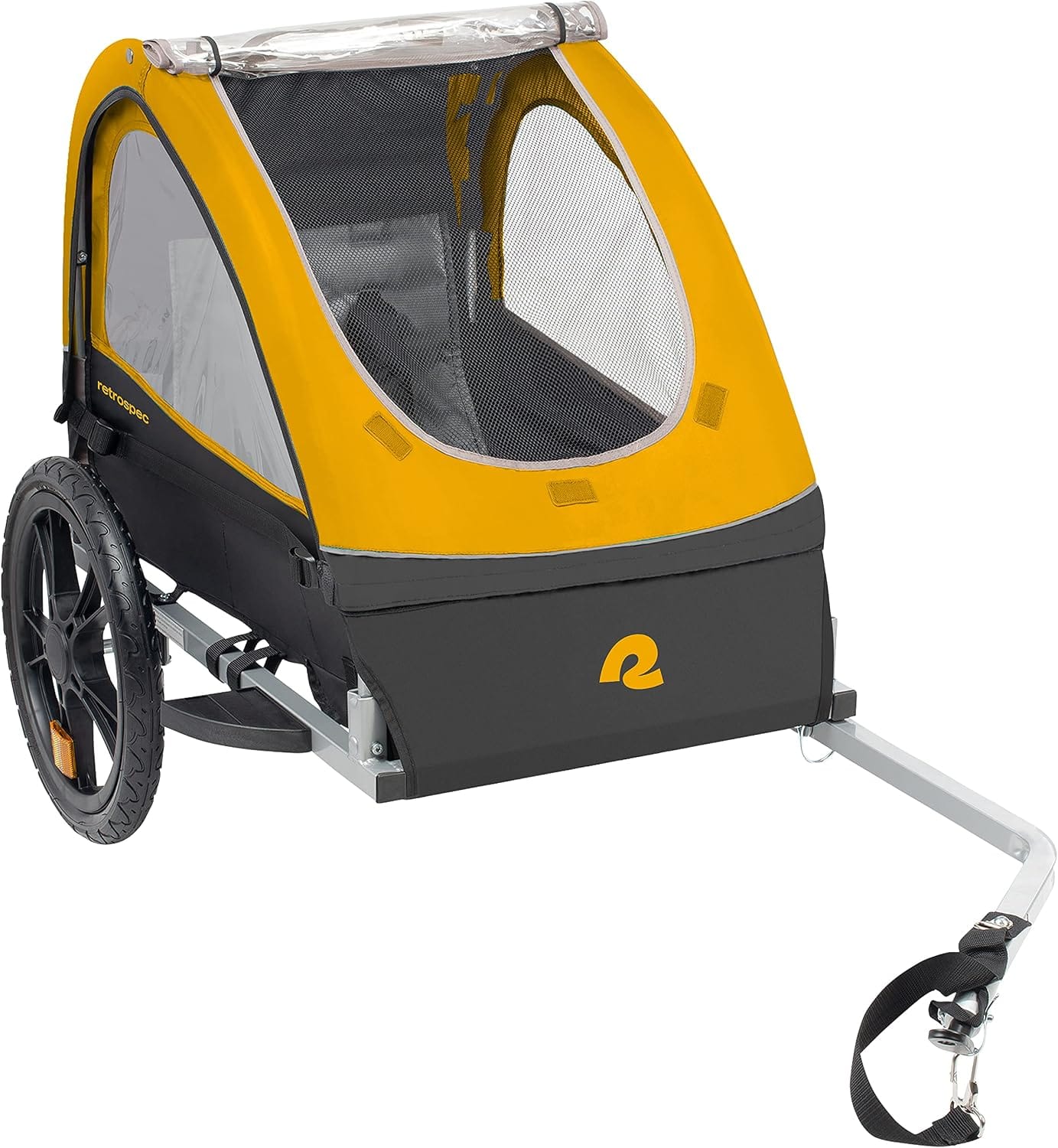
4. Retrospec Rover Kids Bicycle Trailer
Best child bike trailer for visibility and cargo storage
The Retrospec Rover puts more emphasis on being visible from outside the trailer.
In addition to its high-visibility safety flag, Retrospec surrounds parts of the trailer with reflective fabric and adds dedicated reflectors.
Inside is a padded five-point harness.
The Rover is available in single- and double-passenger versions with published recommended weight limits of 40 and 80 pounds respectively. Both use 16-inch wheels.
Its weather-resistant enclosure incorporates front and side shields along with a rear vent window.
There is also a deep rear storage compartment, which is one of the Rover's strongest practical features.
Why we like it
Visibility is particularly important with trailers because they sit substantially lower than the adult cyclist.
No flag or reflective material makes riding risk-free, but using multiple visibility elements makes more sense to us than relying on one bright piece of fabric.
The cargo compartment is also large enough to make the Rover useful beyond a short loop around the block.
Retrospec's own site currently shows strong owner feedback for the Rover, with 144 reviews displayed when we checked.
Bike compatibility deserves attention
Retrospec says the Rover fits most bikes with 20- to 29-inch wheels. Its site also publishes a specific list of Retrospec e-bike models compatible with the trailer.
If you own an e-bike from another manufacturer, check the trailer instructions and bicycle manufacturer's guidance rather than assuming compatibility.
Best for
Families who regularly bring a diaper bag, toys, food or other gear and want more reflective visibility around the trailer.
Skip it if
You specifically need suspension or more than an 80-pound recommended limit in the double configuration.
Key specs
Seats: Single or double configurations
Recommended capacity: 40 lb single / 80 lb double
Wheels: 16-inch
Harness: Padded five-point
Visibility: Reflective fabric, reflectors and flag
Weather protection: Weather-resistant cover and rear vent
Storage: Deep rear compartment
Bike wheels: Designed to fit most 20-29-inch adult bikes
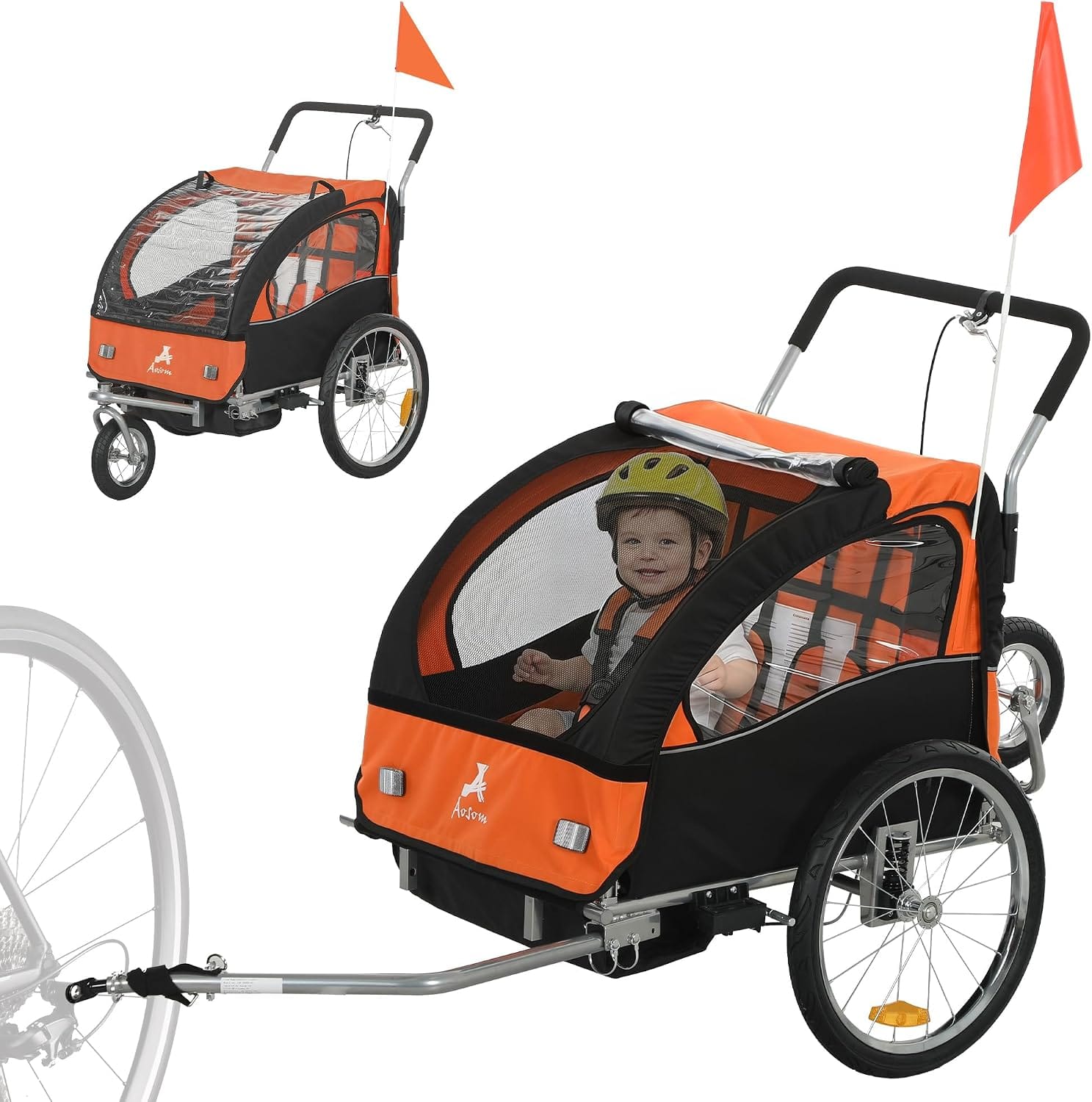
The Aosom Elite 360 is considerably different from the simpler InStep, Allen and Retrospec designs.
It has 20-inch rear wheels, a 10-inch locking swivel front wheel and a suspension system, giving it more of a stroller/trailer design.
The cabin seats two children.
Aosom specifies children under 43.25 inches tall and lists a maximum of 40 pounds per child when used as a bicycle trailer. It also specifies an approved age of 18 months and older for this exact model.
That manufacturer-specific age requirement is important because it is stricter than some general child-trailer guidance.
Inside is a sling-style seat with a five-point harness, while a removable canopy provides some protection from wind.
A large storage compartment sits behind the passenger area.
The feature that separates it
The suspension and larger rear wheels make this the most feature-heavy model among these six.
Its dimensions are approximately 61 inches long, 33.1 inches wide and 42.5 inches high with the connector installed. Folded, the company lists it at approximately 29.25 x 25.5 x 4.5 inches.
So despite being substantial when assembled, it collapses surprisingly flat.
One specification problem you should know about
Aosom's current page is internally inconsistent.
Its product overview and detailed specification table show an 80-pound weight capacity. The same page also contains a marketing bullet saying “up to 88 lbs.”
Later, its detailed passenger specifications again say a maximum of 40 pounds per child in trailer mode.
Because of that conflict, we would treat 80 pounds total / 40 pounds per child as the safer buying number unless the manual included with the exact trailer clearly states otherwise.
This is exactly why checking beyond the Amazon bullet points matters.
Best for
Parents who want a child trailer with larger rear wheels, suspension, front swivel-wheel functionality and generous storage.
Skip it if
You want the lightest and simplest trailer possible.
Key specs
Seats: 2
Trailer-mode passenger limit: 40 lb per child
Recommended height: Under 43.25"
Manufacturer age: 18+ months
Rear wheels: 20"
Front wheel: 10" locking swivel
Harness: Five-point
Frame: Steel
Suspension: Yes
Overall size: 61 x 33.1 x 42.5"
Folded size: 29.25 x 25.5 x 4.5"
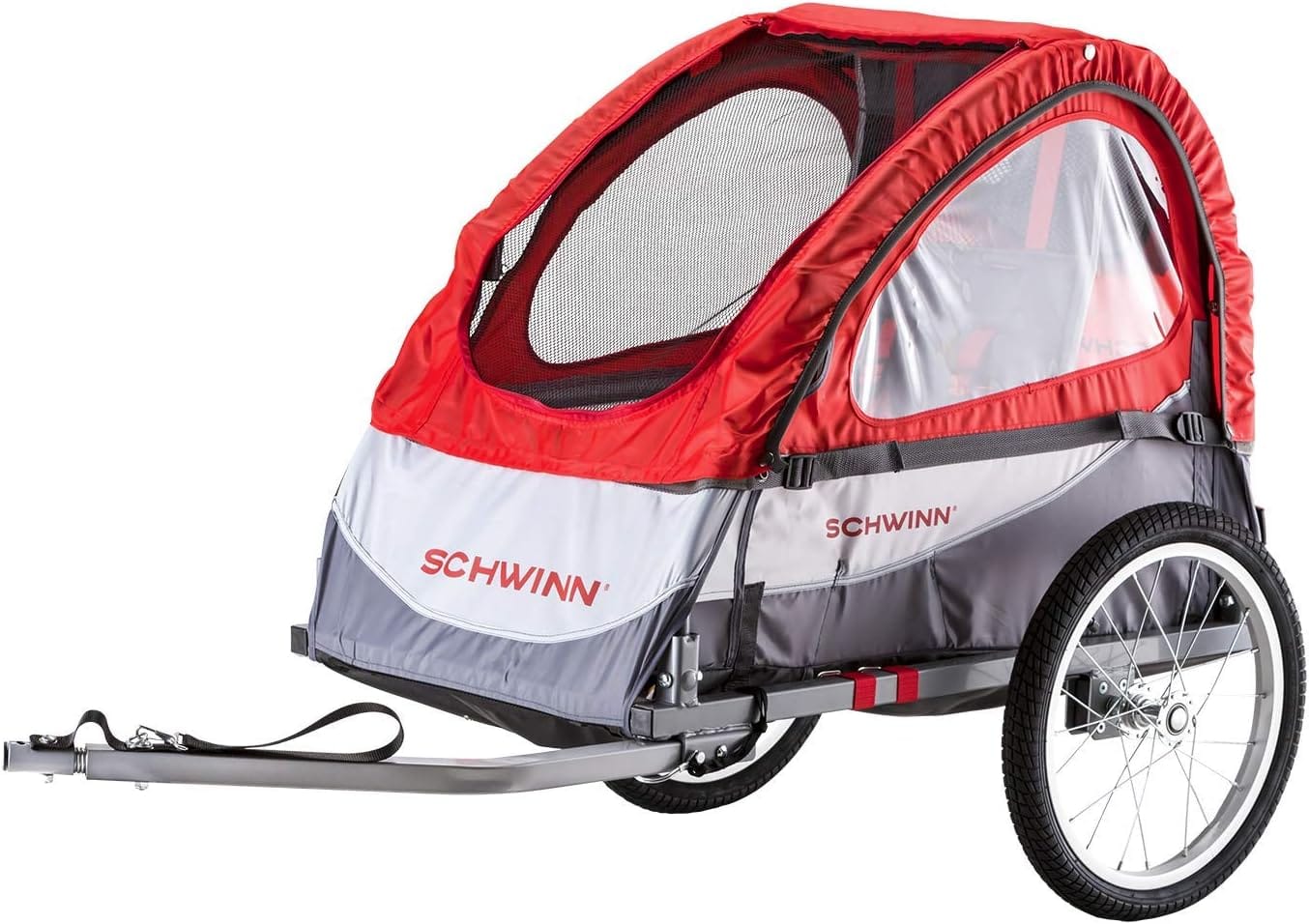
6. Schwinn Trailblazer Plus Kids Bike Trailer
Best single child bike trailer with extra cargo capacity
The Schwinn Trailblazer Plus is another strong option for parents carrying one child.
It supports one passenger up to 40 pounds, but Schwinn also allocates another 12 pounds for rear storage.
That gives it an advantage for parents who routinely bring snacks, drinks, spare clothing, diapers or toys.
The Trailblazer Plus uses 16-inch air-filled tires with molded rims and includes a universal coupler, folding frame and quick-release wheels.
Its two-in-one canopy combines a bug screen and weather shield.
Inside, an upgraded seat and five-point harness secure the passenger.
Why choose this over the InStep Sync?
The two products are very similar on paper.
The biggest reason we see for choosing the Trailblazer is its clearly specified 12-pound rear storage allowance.
If you rarely bring cargo, the simpler InStep Sync remains our first pick.
If every family bike ride looks like you packed for a weekend trip, that extra published storage capacity becomes more valuable.
Best for
One-child families who want a compact trailer but regularly carry additional gear.
Skip it if
You need two seats or more than a 40-pound child capacity.
Key specs
Seats: 1
Child capacity: 40 lb
Rear storage: Up to 12 lb
Wheels: 16-inch air-filled
Harness: Five-point
Canopy: Bug screen + weather shield
Storage: Folding frame, removable wheels and dedicated rear cargo capacity
Attachment: Universal-style coupler
Which child bike trailer should you buy?
For most families, start with the number of children you actually need to carry.
If you have one child, the InStep Sync is our first choice because there is little benefit in constantly towing the extra width of an empty second seat.
If you have two children, the InStep Take 2 is the simplest double option.
The Allen Sports Deluxe becomes more attractive when your children are larger because its double version supports up to 50 pounds per passenger. Just remember that Allen specifically prohibits using its trailers with e-bikes.
The Retrospec Rover is particularly appealing when storage and external visibility features matter.
The Aosom is the one to investigate if you want a more multipurpose design with larger rear wheels, suspension and a front swivel wheel.
The Schwinn Trailblazer makes sense for a solo passenger when you know you will regularly use its extra rear cargo capacity.
Child bike trailer safety: what parents should know
A bicycle trailer changes how your bike accelerates, turns and stops.
The American Academy of Pediatrics recommends bicycle-towed child trailers over bicycle-mounted seats when carrying a young passenger. It also advises riding in parks, on bike paths or quiet streets when possible, avoiding busy roads and riding at reduced speed.
How old should a child be for a bike trailer?
The AAP says infants younger than 12 months should not be carried on bicycles.
Children roughly 12 months to four years who can sit well unsupported and have enough neck strength to support a lightweight helmet may be carried in a child trailer, subject to the trailer manufacturer's instructions.
Manufacturer requirements can be stricter.
For example, Aosom specifies 18 months and older for the Elite model included in this guide.
Always follow whichever requirement is more restrictive for your child and trailer.
Does a child need a helmet inside a bike trailer?
The AAP recommends that young bicycle passengers wear a lightweight bicycle helmet.
In the United States, bicycle helmets should meet CPSC requirements; compliant helmets carry labeling indicating that they meet the federal standard.
Check local helmet laws as well.
Use the harness every time
Every child trailer in our six picks uses a five-point restraint system.
That harness should be adjusted according to the manufacturer's instructions every time the child rides.
Do not allow a child to ride loose inside the cabin simply because the trip is short.
Attach the hitch correctly
Before every ride, check:
- Main coupler connection
- Secondary safety strap if supplied
- Wheel attachment
- Tire pressure
- Harness
- Canopy
- Safety flag
- Frame locking mechanism
A “universal” coupler does not automatically mean universal compatibility with every rear axle, thru-axle, hub motor or e-bike.
How to Choose a Child Bike Trailer
A child bike trailer is one product where specifications genuinely matter.
The color, cup holders and styling are secondary. Passenger limits, interior space, wheel design, hitch compatibility and safety equipment should come first.
Single vs. Double Child Bike Trailers
If you only have one child and do not expect to need another seat, a single trailer is usually the more practical choice.
Single trailers tend to be narrower and easier to maneuver through garage doors, sidewalks and storage areas. They also give you less trailer to pull behind the bicycle.
A double trailer makes more sense when you already have two children who will ride together or expect to need that second seat soon.
The tradeoff is width and weight. Two children plus the trailer and whatever gear you pack behind them can add a substantial amount of weight to the bicycle.
For this reason, we would not automatically buy a double trailer just because it sounds more versatile.
Pay Attention to the Weight Limit
Do not look only at the total advertised capacity.
Also check whether the manufacturer lists a per-child limit.
For example, a trailer may support 80 pounds total but still limit each passenger to 40 pounds.
That means you could not necessarily place a 55-pound child on one side and a 25-pound child on the other simply because their combined weight equals 80 pounds.
It is also smart to consider how close your child already is to the limit.
Buying a 40-pound-capacity trailer for a child who already weighs 37 pounds may not give you much useful life.
And remember that a trailer's cargo allowance is not automatically additional passenger capacity.
Wheel Size and Ride Quality
Most of the trailers in this guide use 16-inch pneumatic wheels, while the Aosom Elite uses larger 20-inch rear wheels.
Air-filled tires can absorb some small bumps and road vibration better than small solid wheels, which is one reason pneumatic tires are common on child trailers.
Larger wheels can also roll over small surface changes more easily, but wheel diameter by itself does not tell you how comfortable a trailer will be.
Ride quality also depends on:
- Tire pressure
- Passenger weight
- Trailer construction
- Seat design
- Suspension
- Road surface
For paved bike paths and neighborhood riding, a basic 16-inch pneumatic setup may be all you need.
If you expect rougher surfaces, look beyond wheel size and check whether the trailer has a dedicated suspension system and whether the manufacturer actually approves it for the terrain you plan to ride.
Folding and Storage Matter More Than You Think
Child bike trailers are much larger than they appear in product photos.
Before ordering one, measure:
- Your trunk opening
- Garage storage area
- Closet or basement space
- Doorways it must pass through
Quick-release wheels can make a major difference because removing the wheels reduces the amount of space the trailer occupies.
A folding frame is also helpful, but “foldable” does not necessarily mean small.
Check the actual folded measurements whenever the manufacturer provides them.
This becomes especially important if you plan to drive somewhere before starting your bike ride.
Check the Hitch Before You Buy
Many child trailers advertise a “universal coupler,” but universal does not necessarily mean every bicycle ever made.
Rear axle designs vary.
Compatibility can become particularly complicated with:
- Thru-axles
- Internally geared hubs
- Disc brake setups
- E-bikes with rear hub motors
- Unusual frame designs
You may need a separate axle adapter even when the trailer itself is compatible with the bicycle.
Check both the trailer manufacturer and bicycle manufacturer rather than assuming the hitch will fit because the listing says “universal.”
The hitch deserves particular attention because CPSC recalls have occurred in the past when trailer connection components could separate from the bicycle. (U.S. Consumer Product Safety Commission)
Weather Protection and Ventilation
A good child bike trailer should protect passengers without completely sealing them inside.
Most of our picks include some combination of:
Bug screen: Helps block insects and larger road debris.
Weather shield: Provides additional protection from wind and light weather.
Ventilation: Allows air to continue moving through the passenger compartment.
Do not treat a weather shield as permission to ride in severe weather.
Young passengers are not generating the same amount of body heat as the adult pedaling the bicycle, so dress them appropriately for the conditions.
Visibility Features
A child trailer sits much lower to the ground than the cyclist towing it.
That is why we like seeing multiple visibility features rather than relying on one.
Look for:
- A tall safety flag
- Reflective material
- Front and rear reflectors
- Bright exterior panels where available
The Retrospec Rover is particularly strong in this area because it combines a flag with reflective fabric and reflectors.
Visibility equipment can help other people notice the trailer, but it does not eliminate the risks associated with riding around vehicle traffic.
Child Bike Trailer Safety
Buying the right trailer is only part of the equation.
A young passenger changes the way a bicycle handles. Added weight can increase braking distance and make the bicycle less stable.
The American Academy of Pediatrics recommends riding with young passengers primarily in parks, on bike paths or on quiet streets rather than busy roads, and recommends riding more slowly and cautiously when carrying a child. (HealthyChildren.org)
Age and Readiness
The American Academy of Pediatrics says babies younger than 12 months should not be carried on a bicycle.
For approximately ages 12 months through 4 years, a child should be able to sit well without support and have enough neck strength to support a lightweight bicycle helmet before being carried in a child trailer. (HealthyChildren.org)
That is general guidance—not permission to ignore the trailer manufacturer's rules.
Some manufacturers set a higher minimum age.
Always follow whichever requirement is stricter.
Use the Harness Every Time
Every trailer we selected includes a five-point harness.
Use it.
Even during a short neighborhood ride, the child should be properly restrained according to the manufacturer's instructions.
Make sure the straps are positioned correctly and snug enough to prevent the passenger from moving around excessively.
Children Should Wear a Helmet
The American Academy of Pediatrics recommends that young passengers wear a lightweight bicycle helmet that meets CPSC requirements. (HealthyChildren.org)
Make sure the helmet fits the child rather than simply buying one they can “grow into.”
Also check that the trailer has enough headroom for the child to sit normally while wearing it.
Do a Quick Check Before Every Ride
You do not need to perform a full mechanical inspection every time you leave the driveway, but a quick check is worth doing.
Before riding, verify that:
- The trailer coupler is fully attached
- Any secondary safety strap is connected
- The trailer wheels are locked into place
- Tires are properly inflated
- The frame is fully opened and locked
- The child's harness is secure
- The safety flag is installed
- Nothing is loose inside the passenger compartment
Pay particular attention to the hitch connection. Historical CPSC recalls involving child bicycle trailers have included failures or improper engagement in towing components that could allow the trailer to detach. (U.S. Consumer Product Safety Commission)
Using a Child Bike Trailer With an E-Bike
E-bike compatibility deserves its own consideration because manufacturers do not all give the same answer.
Do not assume that because a trailer physically attaches to an e-bike, the combination is approved.
E-bikes can introduce different rear axles, hub motors and higher potential riding speeds.
Check:
- The child trailer manufacturer's compatibility requirements.
- Your e-bike manufacturer's towing instructions.
- Whether an axle adapter is required.
- Any speed limitations for towing a passenger trailer.
If either manufacturer says not to use the combination, choose a different setup.
Child Bike Trailer FAQ
Which Child Bike Trailer Should You Buy?
For most families, start with the number of children you actually need to carry.
If you have one child, the InStep Sync is our first choice because there is little benefit in constantly towing the extra width of an empty second seat.
If you have two children, the InStep Take 2 is the simplest double option.
The Allen Sports Deluxe becomes more attractive when your children are larger because its double version supports up to 50 pounds per passenger. Just remember that Allen specifically prohibits using its trailers with e-bikes.
The Retrospec Rover is particularly appealing when storage and external visibility features matter.
The Aosom is the one to investigate if you want a more multipurpose design with larger rear wheels, suspension and a front swivel wheel.
The Schwinn Trailblazer makes sense for a solo passenger when you know you will regularly use its extra rear cargo capacity.
Is Suspension Worth Paying Extra For?
Not every family needs suspension.
The InStep, Schwinn and several other affordable trailers rely primarily on their pneumatic tires rather than a dedicated suspension system.
The Aosom Elite 360 adds actual suspension.
That can become more valuable if your routes have frequent cracks, rough pavement or uneven surfaces.
But suspension should not be treated as permission to take a child trailer onto terrain the manufacturer does not approve.
If most of your riding happens on smooth paved bike paths, we would prioritize a good harness, proper fit, reliable hitch and appropriate weight capacity before paying extra solely for suspension.
What Is The Best Child Bike Trailer For One Child?
Of the six models we compared, the InStep Sync Single Seat Bike Trailer is our best overall choice for one child.
It carries one child up to 40 pounds and includes 16-inch pneumatic tires, a five-point harness, bug screen, weather shield, safety flag and folding frame.
What Is The Best Child Bike Trailer For Two Kids?
The InStep Take 2 is our best straightforward choice for two children, with an 80-pound combined child capacity.
The Allen Sports Deluxe is worth considering when you need a higher passenger limit because its double version supports up to 50 pounds per child.
How Old Does A Child Need To Be For A Bike Trailer?
The American Academy of Pediatrics says children younger than 12 months should not be carried on a bicycle. A child should also be able to sit unsupported and have sufficient neck strength for a lightweight bicycle helmet. (HealthyChildren.org)
Individual trailer manufacturers may require an older minimum age, so always check the manual for the exact trailer.
Does A Child Need A Helmet Inside A Bike Trailer?
Yes. The American Academy of Pediatrics recommends a lightweight bicycle helmet that meets CPSC requirements for a young passenger riding in a child bike trailer. (HealthyChildren.org)
Can A Child Bike Trailer Attach To Any Bicycle?
No.
Many trailers fit a wide range of traditional bicycles, but thru-axles, internally geared hubs, e-bike motors and unusual axle designs can require adapters or may not be compatible at all.
Always verify the exact bicycle-and-trailer combination before riding.
Is A Single Or Double Child Bike Trailer Better?
A single trailer is usually the better choice when you only need one seat because it can be narrower, lighter and easier to store.
A double trailer is better when you actually need to transport two children or know you will need the second seat soon.
Are Child Bike Trailers Safer Than Rear Bike Seats?
The American Academy of Pediatrics states that a bicycle-towed child trailer is preferable when transporting a young passenger, while also emphasizing that carrying a child by bicycle still involves risk. (HealthyChildren.org)
How Much Weight Can A Child Bike Trailer Hold?
It varies substantially.
Among the six trailers in this guide, passenger limits range from 40 pounds for several single-seat models to as much as 100 pounds total for the Allen Sports Deluxe double trailer.
Always check both the total capacity and the manufacturer's limit for each individual passenger.
Can You Put One Child In A Two-seat Bike Trailer?
Generally, manufacturers design their double trailers to accommodate one or two children, but seating position and harness instructions vary.
Follow the manual for the exact trailer rather than choosing a seating position on your own.
How We Researched These Child Bike Trailers
We compared these six child bike trailers based on the things that matter most when actually choosing one for a family: passenger capacity, number of seats, wheel size, harness design, weather protection, visibility, cargo storage, folding design and bicycle compatibility.
We also looked beyond the basic Amazon descriptions when a specification could affect safety or compatibility.
Rather than automatically treating the trailer with the most features as the winner, each model was given a category based on where its design makes the most sense.
That is why our picks include separate winners for one child, two children, higher passenger capacity, storage, suspension and additional cargo room.
We did not claim to personally road-test products we have not tested.
Manufacturer specifications, compatibility information and product availability can change, so buyers should confirm the current manual and product information before transporting a child.
Final Verdict
For most families transporting one child, the InStep Sync Single Seat Bike Trailer is our top pick.
It covers the features that matter without making the trailer unnecessarily complicated: a 40-pound passenger limit, 16-inch pneumatic tires, five-point harness, weather protection, safety flag and folding frame.
For two children, we would move up to the InStep Take 2.
The Allen Sports Deluxe is the more interesting option when higher passenger capacity matters.
Choose the Retrospec Rover if cargo storage and added visibility features are high on your list.
The Aosom Elite 360 has the strongest feature set for families specifically looking for suspension and larger rear wheels.
And the Schwinn Trailblazer Plus makes the most sense when you need one passenger seat but regularly carry extra gear.
The biggest mistake would be choosing solely from a picture or star rating.
Start with the number of children, their weight, your bicycle's compatibility and the surfaces you ride. Then compare the extras.
That is far more likely to lead you to the right child bike trailer than choosing whichever model has the longest Amazon feature list.
This article contains affiliate links. As an Amazon Associate, I may earn from qualifying purchases at no additional cost to you.